Tuesday, December 24, 2013

Oracle Database 10g Express Edition Tutorial


 Oracle Database 10g Express Edition Tutorial!

This tutorial prepares the Oracle Database 10g Express Edition Developer to perform common development and administrative tasks of Oracle Database 10g Express Edition.

Learning Objectives

After taking this tutorial, you should be able to:

Install Oracle Database 10g Express Edition
Access the Oracle Database Home Page
Manage Database Objects
Access and Manipulate Data
Create an Application using HTML DB 2.1
Add PL/SQL Functionality to an Application
Administer and Monitor the Database
Create an Application using Visual Studio .NET
Create an Application using PHP

Click to Download

MACRORIT Disk Partition Expert Free

MACRORIT Disk Partition Expert


Macrorit Disk Partition Expert is powerful free partition software allows you to extend partition  settle low disk space problem, manage disk space easily, it is also the only one free disk partition management software possesses advanced technology of power-off protection and data disaster recovery. This totally free disk management utility is designed for home users which supports 32/64 bit Windows Operating System including Windows XP, Vista, Windows 7 and latest Windows 8.1.

Availability: Free
File Size: 3.9MB

Click To Download


Friday, December 20, 2013

Oracle Database express edition 10G


Oracle Database express edition 10g

Oracle Database XE is the perfect choice for many different groups, including:
• Developers working on PHP, Java, .NET, and other applications that require a database
• DBAs who need a free starter database for training and deployment
• Independent Software Vendors (ISVs) who want to embed an Oracle database in their application or product to extend customer value at no additional cost
• Educational institutions and students who need a free starter database for their curriculum.

Click to Download


Tuesday, December 17, 2013

PAKISTANI STUDENTS SENT SATELLITE TO SPACE VIDEO


PAKISTANI STUDENTS SENT SATELLITE TO SPACE


         iCUBE-1 Launch  .


A Stupendous Achievement by Institute of Space Technology

Pakistan’s first Cubesat satellite, iCUBE-1, was launched on Thursday at 1210 hrs onboard Dnepr launch vehicle from Yasny launch base, Russia. It is welcoming news for Higher Education Institutions, students and researchers of Pakistan that Institute of Space Technology (IST) has etched its name among the foremost universities in the World who have built and launched a cubesat satellite. This CUBESAT satellite will open up a wide vista of future experiments that can be carried on cubesats in the domain of imaging, microgravity, biology, nano technology, space dynamics, chemistry, space physics and various other fields. Cubesats can also provide a test bed for developing satellite constellations for specific applications. Institute of Space Technology has achieved this astounding success in a short span of ten years, owing to the concerted efforts by its leadership, students and faculty to standout in this field and to create a national center of excellence in space technology. The Vice Chancellor IST, Imran Rahman congratulated ‘Team IST’ for this great achievement.  He specifically thanked the Federal Minister for Planning, Development & Reforms, Prof. Ahsan Iqbal, Chairman HEC and Chairman of our National Space Agency for their continuous encouragement, support and help in achieving this milestone.
ICUBE-1 has been launched in a polar orbit, 600 Km above the surface of the Earth, and is designed to take low resolution images of Earth and other space objects. Initially, ICUBE-1 will transmit a Continuous Wave Morse coded beacon with message “ICUBE-1 First CubeSat of Pakistan”. Ham radio operators have a great opportunity to hear those signals on the VHF band. ICUBE-1 has a mass of 1.1 Kg and is thus categorized as a pico-satellite. The satellite has a volume of 10cm cube and it houses several sensors to collect data for scientific purposes. ICUBE-1 is a fully autonomous satellite and is capable of maintaining its health via its on-board computer. The satellite will send its health data to ground stations and can also be commanded from Satellite Tracking and Control Station at IST.
Launch of ICUBE-1 is a significant milestone in the space program of Pakistan as it will motivate our youth to take a more active part in the future satellite development program of Pakistan.

Join Us On Facebook


Wednesday, December 4, 2013

Hyper-threading and its drawbacks


Hyper-threading
(officially Hyper-Threading Technology or HT Technology, abbreviated HTT or HT)
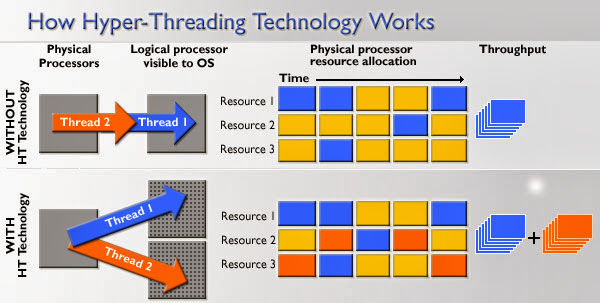
For each processor core that is physically present, the operating system addresses two virtual or logical cores, and shares the workload between them when possible. The main function of hyper-threading is to decrease the number of dependent instructions on the pipeline. It takes advantage of superscalar architecture (multiple instructions operating on separate data in parallel). They appear to the OS as two processors, thus the OS can schedule two processes at once. In addition two or more processes can use the same resources. If one process fails then the resources can be readily re-allocated.

Hyper-threading requires not only that the operating system supports SMT, but also that it be specifically optimized for HTT, and Intel recommends disabling HTT when using operating systems that have not been optimized for this chip feature.

Drawbacks
When the first HT processors were released, many operating systems were not optimized for hyper-threading technology (e.g. Windows 2000 and Linux older than 2.4).
In 2006, hyper-threading was criticised for energy inefficiency. For example, specialist low-power CPU design company ARM stated simultaneous multithreading (SMT) can use up to 46% more power than ordinary dual-core designs. Furthermore, they claimed SMT increases cache thrashing by 42%, whereas dual core results in a 37% decrease.  Intel disputed this claim, stating that hyper-threading is highly efficient because it uses resources that would otherwise be idle.
In 2010, ARM said it might include simultaneous multithreading in its future chips; however, this was rejected in favor of their 2012 64-bit design.

JOIN US ON FACEBOOK


Thursday, November 28, 2013

Core and Thread


Core and Thread

A "core" represents an actual physical subset of a processor that can by itself handle processing, whereas a "thread" is how many actual processes the processor can handle at once. Intel has developed a technology they label "hyper-threading" this technique allows for one physical core (which would normally only be able to handle one thread at a time) to now be able to handle two threads simultaneously.
A thread is a task that the processor must handle, for a simple explanation, you can assume that every application you open (such as paint, notepad, media player) has its own thread... now this does not mean you can only open 2 applications at once, simply because the processor and OS work so fast at 'switching threads' to handle the needs of every application that you have open. You will just experience better performance with more cores because now you can dish out all of the work to more core processors.
For example, a computer has an i7 in it. The i7 has 4 physical cores, but each core can do 'hyper-threading' which allows this processor to handle 8 threads at once. So if you open up the task manager, you will see 8 boxes for processor performance scale.
A general rule of thumb is that more physical cores are better than more threads. So if you were comparing a processors that had 4 cores and 4 threads, would be better than 2 cores 4 threads. But the more threads your processor can handle, the better it will perform while multitasking and for some very intensive applications (video editing, CAD, CAM, Compression, Encryption, etc) will in itself utilize more than one core at a time.

Join us on facebook

Wednesday, November 27, 2013

Intel Core i7 processor families

Intel Core i7 processor families

The latest generation of high-performance Intel x86-compatible microprocessors, branded Core i7, was released on November 17, 2008. Intel Core i7 microprocessors are based on new Nehalem microarchitecture, which, like AMD K8 microarchitecture, replaces Front-Side Bus interface with on-die memory controller with its own dedicated memory bus, and a separate QuickPath Interconnect (QPI) controller that uses point-to-point protocol to communicate with I/O devices and other processors in multi-processor systems. Server-class Core i7 CPUs have two point-to-point links. Other major features of the Nehalem microarchitecture include:
  • Simultaneous Multi-Threading feature adds Hyper-Threading technology to each microprocessor core, which allows any Core I7 quad-core CPU to execute 8 threads at the same time.
  • Each core now includes very low latency non-shared 256 KB level 2 cache. All cores share large level 3 cache.
  • Turbo Boost technology temporary improves CPU performance by increasing core frequency of active cores.
  • Quad-core design on a single die. Previous generation of Intel quad-core processors, Core 2 Quad essentially packed two dual-core processors into one package.
  • Future Core i7 CPUs may have up to 8 cores.
There are many other performance improvements in Core i7 processors, such as enhanced branch prediction, secondary 512-entry TLB buffer, new SSE4.2 instructions, and others.
Intel Core i7 microprocessors are packaged in 1366-land Land-Grid Array (LGA) package, and require socket 1366 motherboards. Future Core i7 processors may also be packaged into 1156-land LGA package.

Intel Core i7-920 - AT80601000741AA / BX80601920 / BXC80601920Picture of: Intel Core i7-920 - AT80601000741AA / BX80601920 / BXC80601920


Core I7 family of quad-core microprocessors incorporates all basic features of the Nehalem microarchitecture - integrated memory controller, Quick Path Interconnect running at 2400 MHz, HyperThreading, Intel 64 technology, 256 KB level 2 cache per core, 8 MB level 3 cache shared between all cores and SSE 4 support. Performance-wise these processors are faster than Core 2 Quad CPUs at the same frequency, and in some applications the difference in performance can be as big as 50%. The Core i7 processors are packaged in new 1366-land LGA package and are not compatible with older Core 2 Duo/Quad motherboards.

Core i7 Extreme Edition family includes top-performance microprocessors based on Nehalem microarchitecture. Aimed at computer enthusiasts, these processors are always clocked higher than Core I7 CPUs released at about the same time, have higher bandwidth due to faster Quick Path Interconnect links, and always come at premium prices. The Extreme Edition processors also have unlocked clock multiplier. The processors are packaged in the same 1366-land LGA package as the Core i7 CPUs, and require socket 1366 motherboards.

Join Us On Facebook